
The Objective
Welcome to the world of Skorch, a thrilling game of strategy and cunning, where the ultimate goal is to race towards freedom. Your objective in Skorch is to outmaneuver your opponents and eliminate all your cards, whether they are held in your hand or imprisoned on the table in front of you. These imprisoned cards, arranged in a unique pattern of face-up and face-down positions during setup, pose both challenges and opportunities that can shape the outcome of the game.
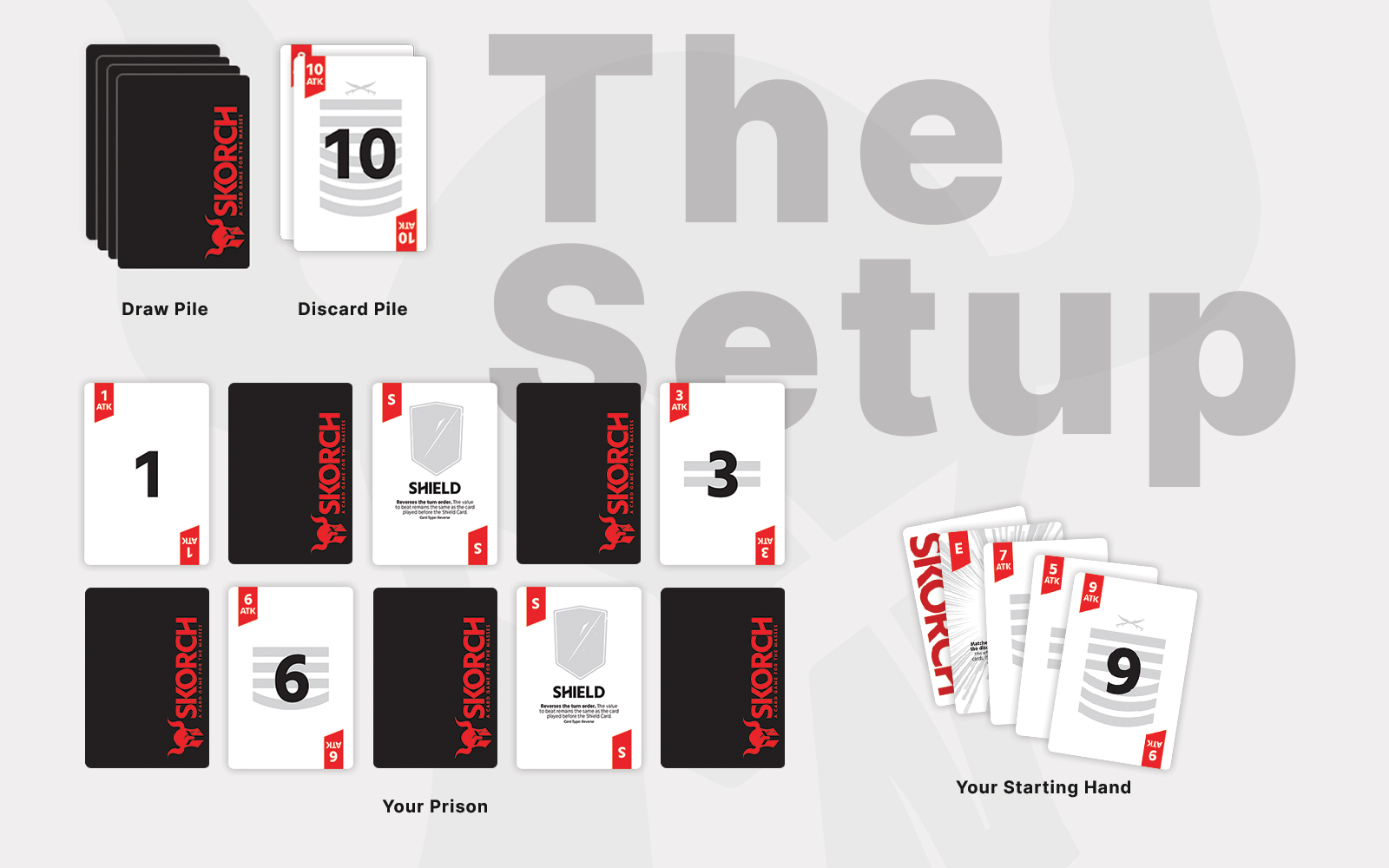
In this tactical duel, you must showcase your strategic prowess as you navigate through your hand and skillfully orchestrate the release of your imprisoned cards. The arrangement of these cards, with three face-down and two face-up cards in the back row, and three face-up and two face-down cards in the front row, demands careful planning and adaptability to seize victory.
Remember, Skorch is not solely determined by the cards you hold, but rather how you utilize them. Employ clever strategic maneuvers, embrace daring bravado, and stay flexible amidst the ever-shifting gameplay. The player who successfully liberates all their cards, both from their hand and the prison, will emerge as the victor. Skorch is an exhilarating journey of adventure, where your tactical skills and decision-making prowess reign supreme. Prepare yourself to enter the game, outsmart your opponents, and ignite the flames of victory in Skorch!
Components:
60 Attack Cards (Ranked 1-10)
4 Elude Cards
4 Shield Cards
4 Demoter Cards
4 Skorch Cards
1 Undead Card
Rulebook
The Setup
- Select a dealer. The dealer is in charge of giving out cards and overseeing the game.
- Shuffle the deck really well to mix up the cards.
- Each player receives five cards at the same time. These cards are dealt in this order: one card facing down, then one card facing up, then one card facing down, then one card facing up, and finally, one card facing down. These cards make up the “back row” of the prison in front of each player.
- The dealer then gives each player five more cards all at once. These cards are dealt in this order: one card facing up, then one card facing down, then one card facing up, then one card facing down, and finally, one card facing up. These cards make up the “front row” of the prison in front of each player. (Note: After the dealing is finished, each player’s prison will have two rows of five cards in front of them.)
- The dealer now gives each player five cards all at once, facing down. These cards are now picked up and placed in the players’ hands and will make up their starting hand. The player can view these cards.
- Finally, the remaining deck of cards is placed face down in the middle of the playing area to create the draw pile. The top card of the deck is turned over and placed next to the deck, creating the starting discard pile. (Note: If the dealer flips a special card at the beginning of the game, that special card becomes the first player’s turn. Instead of following the usual order, the second player after the dealer will start their turn instead.)
There are two piles. The draw pile and the discard pile. The discard pile is played on and the draw pile is drawn from. Once the draw pile is empty, players are no longer required to draw cards.
Gameplay:
- Skorch is a turn-based game, and the player to the left of the dealer generally goes first. Turns then proceed clockwise around the table.
- On your turn, you must play a card from your hand onto the discard pile. The card you play must have equal or higher value than the card on top of the discard pile. Place the card face up on the discard pile.
- Example: if the discard pile has a ‘5’ on top, the player can play any card of value 5 or higher.
- The player then draws a card from the draw pile to end their turn.
- Note: Before playing any cards from the table, you need to get rid of all the cards in your hand. Once you have no cards in your hand, you can only play cards from your front row onto the table. To use cards from your back row, they must first be unlocked.
- How to play Imprisoned cards?
- Cards in the back row are considered “locked,” while cards in the front row are “unlocked.”
- Once a player has exhausted all cards in their hand, they start playing the cards from their front row. The cards from the back row are “unlocked” and available to play only once the corresponding front row card has been played.
- If a player cannot play a card that equals or beats the value of the top card on the discard pile, they must pick up the entire discard pile and add it to their hand.
- You can stack cards of the same value on top of each other in a single play. For example, if you have three 4s, you can place all three on the discard pile at once.
- The game ends immediately when a player successfully plays their last card. The player who accomplishes this is declared the winner, and the game does not continue with more rounds.
Special Cards
- Special cards have unique abilities that can alter the gameplay. These cards can be played on a player’s turn in place of a regular attack card.
- Special cards have specific effects that can help you or disrupt your opponents. Some examples include:
- Elude Card: Matches the value of the top discard pile card but doesn’t copy the effects of Undead or Skorch cards. If played on an empty discard pile, it has a value of 1.
- Shield Card: Reverses the turn order. The value to beat remains the same as the card before the Shield Card.
- Demoter Card: Resets the discard pile value. The next player can play any card, regardless of its value.
- Skorch Card: When you play a Skorch Card, make sure to confidently say “Skorch!” aloud. This card allows you to burn the discard pile, eliminating those cards from the game. Be strategic in using Skorch cards, as there are a limited number of them. Burning the discard pile with the Undead Card is particularly advantageous, as it prevents those cards from resurfacing later. After playing the Skorch Card, the player’s turn ends. The next player can essentially play any card of their choosing.
- Undead Card: Trade one of your unlocked cards with another player’s unlocked card. If you don’t have an unlocked card, you must take another player’s unlocked card without giving one in return.
- Expansion Add-on:
- Face-off Card: Brace yourself for an epic showdown! When you play a Face-off Card, the game takes a thrilling twist. It’s time to unveil the mystery of two face-down attack cards, whether from your front or back row or even both! Out of these two revealed cards, you must select one to place onto the discard pile, regardless of whether it is of higher, equal, or lower value. If it doesn’t beat the discard pile you must pick up the entire discard pile. The remaining revealed card must remain in its position, now face up for all to witness.
- Here’s the twist: if the remaining revealed and now faced-up card was previously locked, it doesn’t automatically become “unlocked” for you. To unlock it, you still need to play the card in front of it. However, be aware that the face-up card is now vulnerable to other players when they use the Undead Card against you. They can seize this card, adding an extra layer of anticipation and strategic planning to the game.
- In case you don’t have any face-down attack cards at the start of your turn, you are free to play any of your attack cards, regardless of whether they are locked or unlocked.
- Learn more about the Face-off Card here.
- Special cards can be played only when it’s your turn, following their specific rules and effects. However, keep in mind that playing a special card will end your turn. You can’t play both an attack card and a special card in the same turn. Choose to play either one or the other.
- Strategically use your special cards like the Mirror Card, Shield Card, Reset Card, Skorch Card, and Undead Card to gain advantages or disrupt your opponents’ gameplay.
Rules and Penalties:
Finalizing Your Turn
- In Skorch, every action you take can tip the scales of the game. To ensure fair play, there’s a specific rule about when your turn officially ends. The moment of conclusion is when you lift your hand or finger from the card you’ve placed on the discard pile.
- For example, let’s say you’re about to play a card from your hand. You move it towards the discard pile, but just as your card touches the pile, you have a change of heart. As long as you have not lifted your finger or hand from the card, you can still retract your move. You can pull your card back into your hand and rethink your strategy.
- However, once your hand or finger has completely lifted from the card and it has settled onto the discard pile, your turn is officially over. You cannot “unplay” the card or retract your move. This rule encourages careful consideration of each move and ensures that each player’s turn is clear and distinct.
- So remember, don’t rush your moves in Skorch. Take the time to think strategically and be sure of your decision before you lift your hand and finalize your turn.
Drawing Rule:
- Regardless of the number of cards a player puts down during their turn, they should only draw one card at the end of their turn as long as there is still a draw pile.
- If you forget to draw a card from the draw pile at the end of your turn, there’s a penalty waiting for you. You’ll have to pay the price by picking up not one, but two cards from the draw pile! But hold on, there’s a rule about catching this mistake: you can only call someone out after the next player has taken their turn. Let’s say Player One forgets to draw and Player Two has already made their move. You’ll have until Player Four’s turn to shout, “Hey, Player One forgot to draw!” Once Player Four has played, it’s too late to call out the missed draw on Player One.
Stashing Rule:
- Now let’s talk about the penalty for sneaky stacking! If you try to sneak a card into a stack that doesn’t match in value, beware of the consequences. If you get caught in the act, you’ll have to face the music and pick up the entire discard pile! The process of calling out a player for this offense follows the same rules as if they had forgotten to draw from the draw pile. However, there’s one crucial difference: if you call someone out and happen to be wrong, the penalty turns against you. Brace yourself to pick up the discard pile as a consequence.
- It’s a dangerous game to play when you try to stash a card that doesn’t match in value with the rest of the pile. In Skorch, there’s a strict rule against this kind of sneaky stashing. If you’re caught attempting to pull off this sly maneuver, you must pick up the entire discard pile as a penalty. That’s a lot of extra cards to handle, so it’s a risky tactic!
- For example, if you have a 5 card and you try to slyly stash it onto a pile of 6’s and then lay that stack on the discard pile, you better hope no one catches you. If any of the other players notice the mismatch and call you out on it, you’re in for a hefty penalty – you’ll have to pick up the entire discard pile.
- Just like when someone forgets to draw from the draw pile, there’s a time limit for catching sneaky stashing. The rules apply the same for calling someone for stashing.
- But there’s a twist! If you accuse someone of stashing, make sure you’re absolutely certain. If you’re wrong and the card actually matches the value of the stack, the penalty boomerangs back to you. You’ll have to pick up the entire discard pile as a consequence.
- For example, suppose Player One tries to stash a card, and Player Two suspects it’s a stash. Player Two calls out Player One, but upon checking the discard pile, the card matches the pile. Now, Player Two must pick up the entire discard pile for the false accusation.
- This rule serves as a fun but challenging element of Skorch, keeping all players on their toes and encouraging fair and honest gameplay.
Revealing Unknown Cards
- Honesty is a cornerstone of Skorch. Every face-down card represents a slice of mystery in the game. These cards are cloaked in secrecy and must not be revealed prematurely. They can only be unveiled under two specific circumstances:
- Playing a Face-Off Card: This special card instigates an exciting twist in the game, allowing you to flip two face-down cards, choose one to be played on the discard pile, and leave the other face-up.
- Playing on the Discard Pile: When it’s your turn and you decide to play a face-down card from your imprisoned cards directly onto the discard pile.
- The mystery of these unknown cards is part of the strategic challenge and unpredictability that makes Skorch a game of suspense and fun.
- If a player is caught cheating by illicitly revealing any face-down card, it’s a serious violation of the game’s principles. The consequence of this breach is immediate disqualification from the current game. The player’s cards are removed from play, and the game continues without them.
- For example, let’s say during the game, Player One suspects that one of their face-down imprisoned cards is an Undead Card, and they’re tempted to sneak a peek to confirm. If Player Two catches Player One peeking at the card, Player One will be disqualified, their cards will be removed, and the game will proceed without them. This rule underscores the importance of honest play, adding a layer of integrity and fair play to the strategic excitement of Skorch.
End of Game:
The game ends when a player has no cards left in their hand and on their table. That player is declared the winner.
Cutthroat Gameplay and Player Alliances:
Skorch encourages strategic gameplay and temporary alliances, which often get turned on their heads as the game progresses. Remember, Skorch is about strategy, cunning, and ruthless fun. Let the games begin!
- Skorch is a cutthroat game where players can engage in table talk.
- Players are encouraged to form alliances and strategies with other players as the game progresses.
- It is common for alliances to form when players see that one player is about to win. Other players may join forces to force the leading player to pick up cards and prolong the game.
- However, alliances can be short-lived and quickly change as players may turn on each other in an attempt to prevent the next player from winning.
- The game’s cutthroat nature adds excitement and unpredictability as players strategize, make alliances, and betray each other in their pursuit of victory.
